A Beginner's Guide to the Categories of the Bible (printable)
Understanding the structure of God's Word is the key to reading it with confidence


Spiritual growth is not accidental. It happens when we take small, intentional steps. Tools are not about replacing the Holy Spirit. They simply remove confusion so you can focus on reading and gleaning from God’s word.
When you understand structure, you make space for depth.
You move from just reading verses to understanding context.
You move from scattered reading to intentional study.
You move from uncertainty to confidence.
And that is such a beautiful shift.
A Simple Chart That Will Change How You See Your Bible
Have you ever opened your Bible and thought, where do I even start?
You are not alone. So many Christian women love God, but feel unsure about how the Bible is organized. It can feel like a big, beautiful library with no map.
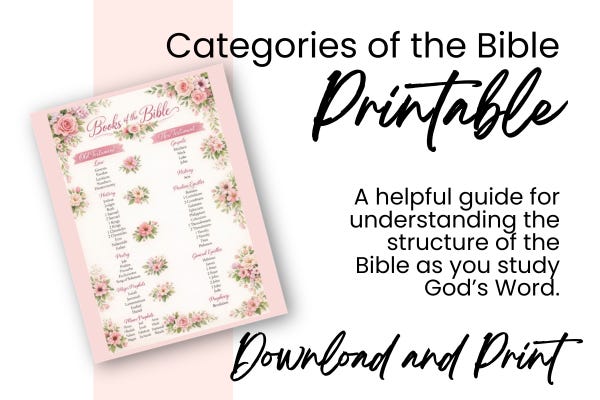
That is exactly why I created this printable Bible categories chart.
It is simple. Clear. And incredibly helpful.
Why This Printable Chart Matters
The Bible is not random. It is intentionally structured. When you understand what type of literature you are reading, everything begins to click.
How This Printable Helps You
This chart gives you a visual overview of the entire Bible.
It helps you:
Feel less intimidated when starting a new book
Understand the flow of Scripture
Recognize patterns in God’s story
Instead of flipping pages feeling lost, you start reading with purpose.
It is especially helpful if you are working through a reading plan, studying one section of the Bible at a time, or simply trying to build consistency in your quiet time.
Categories of the Bible
Here’s the breakdown of the various categories in the Bible:
Old Testament
Law
The law category consists of Genesis, Exodus, Leviticus, Numbers, and Deuteronomy
History
The historical books of the Bible consist of Joshua, Judges, Ruth, 1 Samuel, 2 Samuel, 1 Kings, 2 Kings, 1 Chronicles, 2 Chronichles, Ezra, Nehemiah and Esther
Poetry
The poetry books of the Bible include Job, Psalms, Proverbs, Ecclesiastes and Song of Solomon.
Major Prophets
The major prophet category includes Isaiah, Jeremiah, Lamentations, Ezekiel and Daniel. Note: Daniel can be considered as a work of prophecy.
Minor Prophets
The minor prophets include Hosea, Joel, Amos, Obadiah, Jonah, Micah, Nahum, Habbakuk, Zephaniah, Haggai, Zechariah and Malachi
New Testament
Gospels
The gospels include Matthew, Mark, Luke and John
History
The book of Acts shares the history of the new testament church.
Pauline Epistles
The Pauline epistles were letters from Paul to the various churches and pastors. They include Romans, 1 Corinthians, 2 Corinthians, Galatians, Ephesians, Philippians, Colossians, 1 Thessalonians, 2 Thessalonians, 1 Timothy, 2 Timothy, Titus and Philemon.
General Epistles
The general epistles were other letters written by various authors and include Hebrews, James, 1 Peter, 2 Peter, 1 John, 2 John, 3 John, and Jude.
Prophecy
Revelation is the only book of prophecy in the New Testament.
When you know where a book fits, you understand what kind of writing you are reading. You begin to ask better questions. You gain confidence. And confidence changes everything.
A Tool For Women Who Want More
If you are hungry to grow. If you want to stop feeling overwhelmed. If you desire to open your Bible and actually understand what you are reading. This printable was created for you.
Print it out. Tuck it into your Bible. Keep it in your study binder. Use it when you plan lessons. Use it when you disciple your children. Use it when you feel stuck.
Let it be a gentle guide as you deepen your walk with the Lord.
You do not have to feel lost in Scripture. You can grow. You can understand. And you absolutely can become confident in handling the Word of God.
To grab all the exclusive content in the Hey Creative Sister Collective, click HERE.
