The Story Behind the Tallit and the Tzitzit
Uncovering the rich meaning behind one of Scripture's most overlooked symbols

Have you ever read a familiar Bible story and suddenly realized there was so much more happening beneath the surface than you first noticed? That’s one of the most exciting things about digging into the Hebrew roots of our faith. When we understand the cultural and religious world that Jesus lived in, the Scriptures come alive in ways that can leave you absolutely breathless.
Today, let’s explore one of those hidden gems: the tallit and tzitzit, and what they reveal about Jesus and the people around Him.
A Command to Be Set Apart
From the very beginning, God called the Israelites to be a people distinct from the pagan nations surrounding them. This wasn’t about pride or superiority. It was about identity, purpose, and devotion. One of the beautiful ways God marked His people was through the command to wear fringes, or tzitzit, on the corners of their garments.
“Thou shalt make thee fringes upon the four quarters of thy vesture, wherewith thou coverest thyself.” -Deuteronomy 22:12 (KJV)
The fuller instruction is given in Numbers, where God explains not just the what but the why:
“Speak unto the children of Israel, and bid them that they make them fringes in the borders of their garments throughout their generations, and that they put upon the fringe of the borders a ribband of blue: And it shall be unto you for a fringe, that ye may look upon it, and remember all the commandments of the LORD, and do them; and that ye seek not after your own heart and your own eyes, after which ye use to go a whoring: That ye may remember, and do all my commandments, and be holy unto your God. I am the LORD your God, which brought you out of the land of Egypt, to be your God: I am the LORD your God.” -Numbers 15:38–41 (KJV)
Did you catch that? The fringes weren’t merely decorative. They were a living, wearable reminder, a daily prompt to keep the eyes and heart fixed on God’s commandments rather than drifting toward the distractions of the world. What a practical act of worship!
The Tzitzit: More Than Just a Tassel
The tzitzit (fringes or tassels) worn by devoted Jews are found on a garment called a tallit. Today, this comes in two forms: the tallit gadol, a large prayer shawl worn during worship, and the tallit katan, a smaller undergarment worn throughout the day as a constant reminder of God’s presence and commands.
The construction of the tzitzit itself is very intentional. The 613 knots and coils wound into each fringe correspond to the 613 commandments (mitzvot) found in the Torah. Every time a Jewish person glanced down at those fringes, they were seeing a physical representation of the entirety of God’s law, a wearable Scripture, so to speak. Numbers 15:39 beautifully captures this purpose:
“that ye may look upon it, and remember all the commandments of the LORD.”
Woven into each fringe was also a thread of blue called tekhelet, a color symbolizing heaven, the sky, and the divine presence of God. That small thread of blue was a constant reminder to keep a heavenly focus and to remember that life lived in the presence of Almighty God.
The Woman Who Touched the Hem of Jesus’ Garment
Now here’s where things get wonderfully exciting! You’ve read the biblical account of the woman with the issue of blood. For twelve long years she suffered. Twelve years of pain, isolation, and heartbreak. And then she heard that Jesus was nearby.
She pressed through the crowd and reached out to touch the hem of His garment and she was instantly healed.
But was it really just an ordinary hem?
The Greek word used in that passage is kraspedon, which can be translated as hem, edge, border, corner… and tassel. This is the same word used for the tzitzit. What this woman reached out and touched, in an act of desperate, trembling faith, were the fringes of Jesus’ prayer shawl, the very tassels that God had commanded His people to wear as a reminder of His law and His presence.
Think about that for a moment. She wasn’t grabbing at a random piece of fabric. She was reaching for something sacred, something set apart, something that pointed directly to the covenant promises of God.
And Jesus, was wearing them.
His tzitzit carried the weight of 613 commandments, a thread of heavenly blue, and the identity of a covenant-keeping God.
And healing flowed from them.
What Jesus Said About the Tassels
Jesus Himself acknowledged the wearing of tzitzit and He had some pointed things to say about how some people used them. In one of His most direct confrontations with religious hypocrisy, He spoke about the Pharisees:
“But all their works they do for to be seen of men: they make broad their phylacteries, and enlarge the borders of their garments.” -Matthew 23:5 (KJV)
That word translated as borders here? It’s kraspedon which is the tzitzit again. Yeshua wasn’t criticizing the wearing of tzitzit. He was criticizing the motive behind making them extravagantly long. The Pharisees wanted to appear more spiritual, more devoted, more righteous than everyone else. They turned a symbol of humble obedience into a fashion statement for their own pride and glory.
Jesus’ rebuke wasn’t “stop wearing tzitzit.” His rebuke was: “Check your heart.” The fringes were meant to point people toward God and not to draw admiration toward themselves. The outward symbol must always reflect an inward reality.
When David Cut the Hem of Saul’s Garment
Here’s another passage that takes on breathtaking new meaning in light of what we know about tzitzit.
In 1 Samuel, David had an opportunity to kill King Saul while he slept in a cave, but he refused to harm the Lord’s anointed. Instead, he crept forward and cut off the hem of Saul’s robe. And then, almost immediately, his heart smote him with guilt.
“And it came to pass afterward, that David’s heart smote him, because he had cut off Saul’s skirt. And he said unto his men, The LORD forbid that I should do this thing unto my master, the LORD’s anointed, to stretch forth mine hand against him, seeing he is the anointed of the LORD. So David stayed his servants with these words, and suffered them not to rise against Saul. But Saul rose up out of the cave, and went on his way. David also arose afterward, and went out of the cave, and cried after Saul, saying, My lord the king. And when Saul looked behind him, David stooped with his face to the earth, and bowed himself.” - 1 Samuel 24:5–8 (KJV)
Why did David feel such immediate remorse over cutting a piece of fabric?
Because it wasn’t just fabric. It was the tzitzit, the corner fringe of Saul’s garment.
In Jewish tradition, the tzitzit represented life and vitality. When a Jewish person died, the tzitzit was cut from their tallit and buried with them, or removed entirely, because a dead person was no longer obligated to keep the commandments.
By cutting off Saul’s tzitzit, David had symbolically enacted the death of Saul and the end of his kingdom. It was a profound, weighty act and David knew it the moment he did it. Even if he hadn’t planned to attack Saul physically, he had made a symbolic statement about the king’s reign that shook him to his core.
Did Jesus Wear a Tallit or Tzitzit?
So, did Jesus wear a tallit and tzitzit? Everything we know about His culture, His faith, His observance of the Torah, and the very words of Scripture strongly suggests that yes, He did. He was a Jewish rabbi who walked in the fullness of the law He came to fulfill (Matthew 5:17). The woman with the issue of blood knew exactly what she was reaching for. She was reaching for the covenant promises of God, wrapped up in the fringes of the Messiah’s garment.
You don’t have to wear a tallit to apply this truth to your own life. But you can let it deepen your wonder at who Jesus really is. He not a figure divorced from history and Jewish culture, but a covenant keeping Son of God who wore the Law on the very corners of His garment and carried healing in His fringes.
Should Christian Believers Wear the Tallit or Tzitzit?
For Christian believers, the question naturally arises, are we required to wear a tallit or tzitzit today? The answer is no, and the reason is worth celebrating.
The tzitzit were given as a physical reminder to remember and obey God's commandments, but Paul explains in Galatians 3:2425 that "the law was our schoolmaster to bring us unto Christ, that we might be justified by faith. But after that faith is come, we are no longer under a schoolmaster."
Another Scripture that helps us answer the question if believers should wear tallit/tzitzit is Matthes 5:17: Think not that I am come to destroy the law, or the prophets: I am not come to destroy, but to fulfil.
The fringes were a shadow, a teaching tool, a tangible pointer toward the Messiah who was coming.
Under the New Covenant, the Holy Spirit Himself becomes that reminder, writing God's law not on the corners of a garment but on the tablets of our hearts. As Jeremiah prophesied and the New Testament confirms in Hebrews 10:16, "This is the covenant that I will make with them after those days, saith the Lord, I will put my laws into their hearts, and in their minds will I write them."
For the Hey Creative Sister Collective
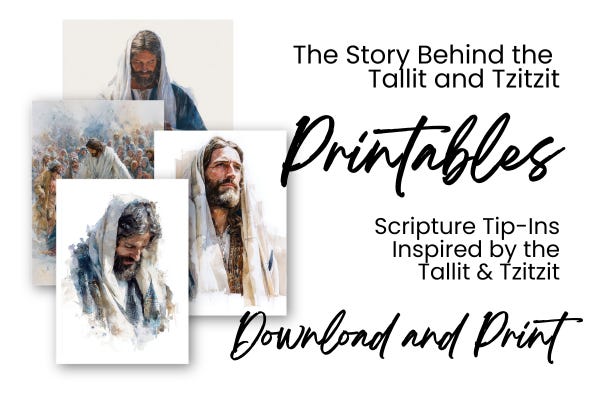
My prayer is that this truth doesn’t just stay on the page of God’s word, but settles deep into your heart. Just like the tzitzit were meant to be a visible reminder to keep God’s Word before His people, I want to give you something to help you do the same. I’ve created a few graphics for you that you can use as Bible tip-ins. They are visual reminders you can place right into your pages so this teaching stays close every time you open your Bible.
May you walk in the wonder of a faith that is deeper, richer, and more beautifully rooted as you study God’s Word.
